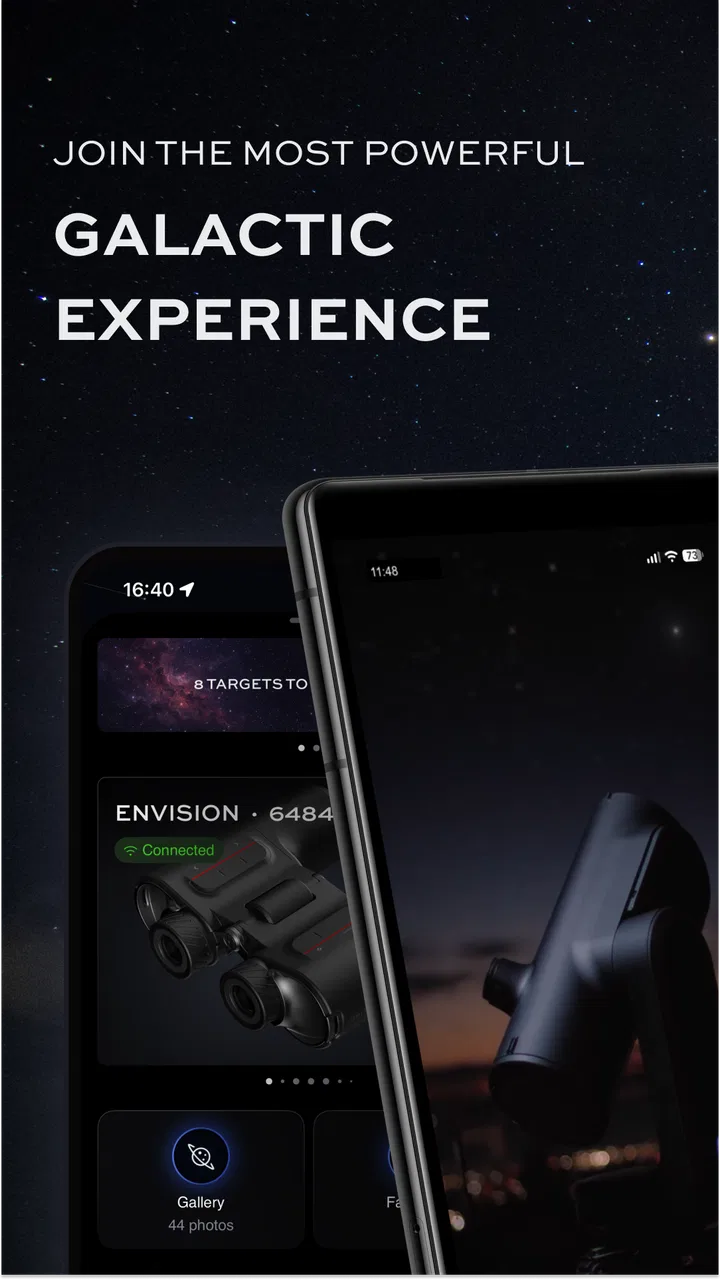
Unistellar
- 3.6
- Rating
- 50.00K
- Installs
- Free
- Price

 Analysis by App-foxy
Unistellar is an astronomy app from Unistellar that immediately feels more purposeful than a typical sky map. I found its appeal in the way it invites me to look upward with a specific goal rather than simply browse a picture of the night sky. It belongs to the Libraries & Demo category, is free to use, and is rated for Everyone, so it is easy to approach whether you are already interested in astronomy or are just beginning to recognize stars and planets.
The first impression is helped by the app’s clear identity. Its store summary describes it as a way to become a pioneer of a new astronomy, and that idea comes through in the overall tone: this is aimed at people who want to feel involved in observing, not merely entertained by space imagery. I would recommend giving it a fair trial during a calm evening rather than opening it for thirty seconds indoors. The value becomes clearer when the phone is part of an actual observing routine.
What Unistellar feels like after the first week
During the first week, the strongest attraction is the sense of discovery. I can imagine opening the app before going outside, checking what might make the evening interesting, and then using that intention to guide the session. That small change matters. Many astronomy tools are excellent reference maps, but they can leave beginners staring at a crowded screen without knowing what deserves attention. Unistellar feels more connected to the act of observing.
You May Also Like

 Blood Strike: 2.5 Anniversary
Blood Strike’s Loadouts Turn Every Drop Into a Tactical Gamble
A close look at Blood Strike’s custom loadouts: how fast access to signature weapons reshapes its battle royale rhythm, rewards preparation, and narrows the gap between fights.

 Pandora - Music & Podcasts
Pandora’s Music Is Easy to Start, but Harder to Recover
Pandora’s strength is its low-effort path from a seed to a station. Its weak spot is how much confidence it asks you to place in connection, setup, and quiet recovery.

 8 Ball Pool
 Is Built on Rivalries, Rematches, and Routine
A close look at the rivalries, rematches, shared routines, and unanswered safety questions that turn a quick pool match into a persistent mobile community.

 Samsung Music
’s Quiet Strength Is Playing What You Already Own
Its reach comes less from spectacle than from dependable access to a personal library. That simplicity is both the app’s strongest retention engine and its ceiling.

 AccuWeather: Weather Radar
AccuWeather Review: A Quick, Clear Forecast for Everyday Decisions
For everyday plans, the best forecast is the one you can understand quickly. AccuWeather makes rain timing, radar, and local conditions easy to act on, with a few trade-offs.

 Hill Climb Racing
Why Hill Climb Racing Still Turns Crashes Into One More Run
A tiny car, a bumpy hill and one more upgrade: Hill Climb Racing keeps resurfacing because its simple chaos makes every near-miss feel personal.
More From Our News Desk
View All News


The app’s role is especially appealing for someone who has recently bought astronomy equipment or has started paying attention to the sky from a balcony, garden, or quiet roadside location. It gives the activity a practical starting point. Instead of asking, “What can I see?” I am encouraged to think, “What should I try to observe tonight, and what should I learn before I begin?” That makes the first few sessions feel less random.
I also like that it sits between a learning tool and a companion for real observation. It is not presented as a general entertainment app, and it does not need to be. The best use is active: prepare, observe, check what you found, and remember the result. That loop is more satisfying than endlessly swiping through unrelated celestial objects.
One useful habit is to spend a few minutes with the app before leaving the house, then put the phone away while observing. This prevents the screen from becoming the main event. I use the app as a guide and reference point, not as a replacement for looking at the sky. That distinction is important because the experience is strongest when the software supports curiosity rather than competing with the view.
The first week can also reveal whether the app matches your expectations. If you want a deep, text-heavy astronomy encyclopedia, a dedicated reference resource may suit you better. If you want a simple way to connect preparation with an evening outside, Unistellar has a more focused appeal. Its free price removes the need to make a financial commitment before discovering which kind of astronomy experience you actually enjoy.
A better way to use it than casual scrolling
My practical recommendation is to choose one small objective for each session. It might be identifying a familiar object, learning the difference between a planet and a star, or preparing for a planned observation with compatible equipment. A narrow objective keeps the app useful and stops it from becoming another application that is opened out of habit and abandoned five minutes later.
It is also worth keeping a simple personal note after an observation. Write down what you intended to see, what you actually noticed, and what confused you. The app becomes more valuable when it is part of that learning record. This is one of the less obvious strengths of a focused astronomy companion: it can turn isolated evenings into a gradual skill-building process.
Families may find this approach particularly effective. With an Everyone content rating, the app can support a shared activity without requiring children to begin with technical terminology. I would still guide younger users rather than hand over the phone and expect the software to teach everything automatically. The conversation around the observation is where much of the educational value appears.
Why the value may last from month to month
The novelty of any astronomy app eventually fades if every session feels identical. Unistellar has a better chance of staying useful when I treat it as part of a recurring observing habit. Its long-term value comes less from opening it daily and more from returning when the sky, equipment, or personal interest gives me a reason to look again.
That makes it different from a conventional sky map. A general map is often opened for quick identification, then closed once the answer is found. Unistellar feels more relevant to an ongoing relationship with observation. It can sit in the preparation stage, help organize attention, and encourage me to revisit the same subject with more understanding. For a newcomer, that progression is more meaningful than collecting a large number of isolated facts.
There is also a useful distinction between occasional and committed users. Someone who only wants to identify a bright object once may find a simpler map faster. Someone who expects to learn, observe, and return to the activity over time is more likely to appreciate this app’s specialized character. I would not describe it as essential for every phone owner, but I can see it earning a permanent place for people who have made astronomy one of their regular interests.
The app was released on December 16, 2019, and its current version is 4.2.1. Those details matter less than the practical question of whether the experience still fits your routine. A current version can make an app feel more dependable, but lasting value still depends on how often you have a reason to use it. I would judge it by the quality of repeated observing sessions, not by the excitement of the first download.
Its audience has grown to over fifty thousand installs, with an average rating of 3.6 from around four hundred ratings and roughly sixty reviews. I read that as a sign of a specialized product with a mixed but meaningful reception rather than a universally effortless experience. The rating is not high enough for me to recommend it blindly, yet it is also not a reason to dismiss the concept. Astronomy tools often divide users because expectations vary sharply between beginners, hobbyists, and people looking for advanced control.
Where it fits beside familiar alternatives
Compared with a basic star-identification app, Unistellar is less about turning the phone into a quick visual labeler and more about supporting an astronomy-centered workflow. A basic alternative may be better when speed is the only priority. Open it, point the phone, find the name, and move on. Unistellar is a better candidate when you want the identification step to lead into actual observing and learning.
Compared with a broad astronomy encyclopedia, it is more approachable but potentially less satisfying for someone who wants extensive background reading. An encyclopedia can answer questions about history, science, and terminology in depth. Unistellar’s strength is the bridge between information and action. I would use the two kinds of tools together if I were becoming serious: one for orientation and one for deeper study.
It also differs from a purely social astronomy platform. If your main motivation is sharing photographs, chatting with other observers, or comparing equipment, this app should not be expected to replace a community. Its usefulness is more personal and practical. It helps me prepare for my own observation rather than making the social layer the center of the experience.
That distinction helps answer an important question: should a beginner choose this instead of a familiar free sky map? My answer is yes if the beginner wants a guided path into observing, especially alongside Unistellar’s astronomy ecosystem. My answer is no if the only goal is occasional object identification or if the user prefers a large, general-purpose astronomy database. The right choice depends on the habit you want to build.
Maintenance, friction, and the work required to keep using it
The maintenance burden is not mainly about complicated upkeep inside the app. It is about maintaining the surrounding habit. Astronomy depends on clear opportunities, patience, and preparation. If I only open Unistellar when I suddenly feel curious, I may not get much from it. The app works better when I keep a loose routine: check ahead, choose a manageable goal, and allow enough time to observe without rushing.
That routine has a practical advantage. It reduces the temptation to judge the app after a poor session caused by clouds, city lighting, fatigue, or an unrealistic target. A disappointing evening is not necessarily a software failure. I learned to separate the quality of the tool from the quality of the observing conditions. That is a useful mindset for anyone deciding whether to keep it installed.
There is still some friction. A person who expects instant results may find astronomy preparation slow, especially when the app is used alongside physical equipment or an outdoor session. The phone is not always convenient in darkness, and the desire to keep checking the screen can interrupt concentration. I recommend lowering the screen brightness before going outside and using the app in short bursts, although the exact settings and workflow will depend on the device.
Another maintenance issue is expectation management. The app can encourage me to plan an observation, but it cannot guarantee a dramatic view every time. Beginners may assume that identifying an object means it will look spectacular through any setup. In practice, the reward can be subtle: recognizing a target, noticing a change, or understanding why an object is difficult. Unistellar is more rewarding when I value progress rather than constant visual excitement.
For users with an older phone, compatibility deserves attention before settling into a routine. The listed minimum operating system is Android 10, so anyone using an earlier Android version should not assume the app will be a practical option. That is a straightforward reason to choose another astronomy resource if updating the device is not possible.
Small workflow choices that improve the experience
I would begin by deciding whether the session is for learning or observing. For learning, I can spend more time reading and comparing objects. For observing, I keep the phone available only when I need orientation. Mixing both goals constantly creates screen fatigue and makes the evening feel like ordinary phone use.
A second useful choice is to prepare a fallback target. If the main object is difficult to find, blocked by the surroundings, or disappointing in the available conditions, a backup keeps the session alive. This is a simple but important advantage of planning with an astronomy app: the evening does not have to end just because the first idea fails.
Finally, I would revisit topics instead of trying to absorb everything in one sitting. Astronomy rewards repetition. The first pass may only establish a name; later sessions can add context and recognition. Unistellar becomes more valuable when I allow that gradual learning curve rather than demanding a complete lesson every time I open it.
What may cause fatigue after the novelty fades
The biggest source of fatigue is repetition without a personal objective. If I use the app only to browse, its specialized focus can start to feel narrow. The same thing happens when every session follows the same pattern and I never connect the information to a real observation. The solution is not necessarily more screen time; it is choosing a different purpose for the next session.
Another possible frustration is the gap between an accessible interface and the complexity of astronomy itself. A friendly app can make the first steps easier, but it cannot remove the need to learn orientation, timing, visibility, and equipment limits. Someone who wants instant certainty may blame the app when the real challenge is the sky. I appreciate tools that simplify the beginning, but I do not expect them to turn astronomy into a push-button activity.
The mixed average rating also suggests that the experience may not satisfy everyone equally. I would be cautious about recommending it to a user who wants a polished all-purpose planetarium, advanced technical controls, or a large community in one place. Those needs point toward other types of astronomy software. Unistellar’s focused identity is a strength for the right user and a limitation for the wrong one.
There is a further trade-off between guided discovery and independence. Beginners may appreciate having a clear route into the subject, while experienced observers may prefer to plan everything themselves. If I already have a mature observing workflow, I might use the app selectively rather than depend on it for every session. That is not a failure; it simply means the app’s role can shrink as my own knowledge grows.
I would also avoid treating the app as a substitute for reliable preparation. Weather, local light conditions, safe outdoor access, and personal comfort still matter. The best astronomy companion can only support the decisions I make. If the practical circumstances are poor, a different activity or a different reference tool may be more sensible that night.
Who should keep it installed
I think Unistellar is a strong fit for a curious beginner who wants astronomy to become an activity rather than a collection of facts. It is also suitable for someone who already has an interest in Unistellar’s approach to observing and wants a dedicated companion instead of a generic map. The free price makes experimentation easy, and the Everyone rating keeps the audience broad.
I would be more selective with experienced astronomers. If you already know exactly what you want from a technical planning tool, you may find this app too guided or too limited for your established method. In that case, a specialized planetarium, equipment-control application, or detailed reference source could be a better primary tool. Unistellar may still be useful as a secondary companion, especially when introducing someone else to the hobby.
For families, I would recommend using it collaboratively. Let one person prepare the target, another locate the relevant information, and everyone share what they noticed. That turns the app from a solitary screen into a starting point for conversation. It is a realistic way to make the experience last because the habit is tied to time together, not just to an icon on a phone.
For casual users, the decision is simple: install it if the idea of planning a real observing session sounds appealing. Skip it if you only want a fast answer about a bright object and do not expect to return to astronomy. A general map will probably be more efficient for that narrow purpose.
My long-term verdict
After the initial excitement, Unistellar earns lasting space only when I give it a job. That job is not to fill spare minutes or replace every other astronomy resource. It is to help turn curiosity into a repeatable observing habit, with enough structure to make each session feel intentional.
I value its focused identity, free access, and beginner-friendly entry point. I also appreciate that it encourages a relationship with the sky rather than treating astronomy as a decorative theme. The limitations are real: it may feel narrow beside a broad planetarium, its usefulness depends on outdoor conditions and personal effort, and users seeking advanced or social features may need another tool.
My recommendation is therefore positive but specific. Install it if you want a dedicated astronomy companion and are willing to spend time observing, learning, and returning to the subject. Use short preparation sessions, keep the phone from taking over the evening, and judge progress across several outings rather than one spectacular first impression. The lasting value comes from the habit you build around the app, not from novelty alone.
Unistellar is not the universal answer for everyone interested in space. For the right person, though, it can be the nudge that turns “I should look at the stars sometime” into a regular, thoughtful activity. That is a modest promise, but in my experience it is the kind that has the best chance of surviving after the first week.
FAQs for Unistellar
01What is Unistellar and what does it offer?
Unistellar is an innovative app designed to enhance astronomical experiences. It pairs with the Unistellar eVscope to provide users with augmented viewing capabilities, allowing even amateur astronomers to explore the night sky with ease. The app offers real-time image processing, object recognition, and a community-driven database of celestial events.
02Is Unistellar compatible with all telescopes?
Unistellar is specifically designed to work with the Unistellar eVscope. It leverages the eVscope's technology to provide its unique features, such as enhanced image processing and object tracking. It is not compatible with other telescopes, so users must own or purchase an eVscope to enjoy the full benefits.
03Does Unistellar require an internet connection to function?
While Unistellar can operate offline for basic features, an internet connection is required for accessing the full range of functionalities. This includes downloading updates, participating in the global citizen science network, and accessing the latest celestial event data. A stable connection ensures the best user experience.
04How user-friendly is the Unistellar app for beginners?
The Unistellar app is designed with user-friendliness in mind, offering an intuitive interface that guides users through setup and usage. Beginners will find the app accessible, with tutorials and a user guide included to help navigate its features. The app aims to make astronomy more approachable for users of all levels.
05What kind of support does Unistellar offer if I encounter issues?
Unistellar provides comprehensive support through various channels. Users can access an online help center with FAQs, tutorials, and troubleshooting guides. Additionally, there's customer service support via email, and an active community forum where users can share experiences and solutions. This ensures assistance is readily available for any issues.
Pros
- User-friendly interface enhances experience.
- Accurate star mapping for astronomy enthusiasts.
- Real-time notifications for celestial events.
- Compact design for easy portability.
- Seamless connectivity with smart devices.
Cons
- Requires clear skies for optimal use.
- Limited battery life during extended sessions.
- Subscription needed for premium features.
- High initial cost may deter casual users.
- App updates can be infrequent.

Unistellar
Gallery